Follow along and make some infused Violet Oil with me!
This is one of my favorite winter oils. I start to crave it about this time of year when the temps here in the northeast drop to the teens and twenties.
It is delicate and luscious.
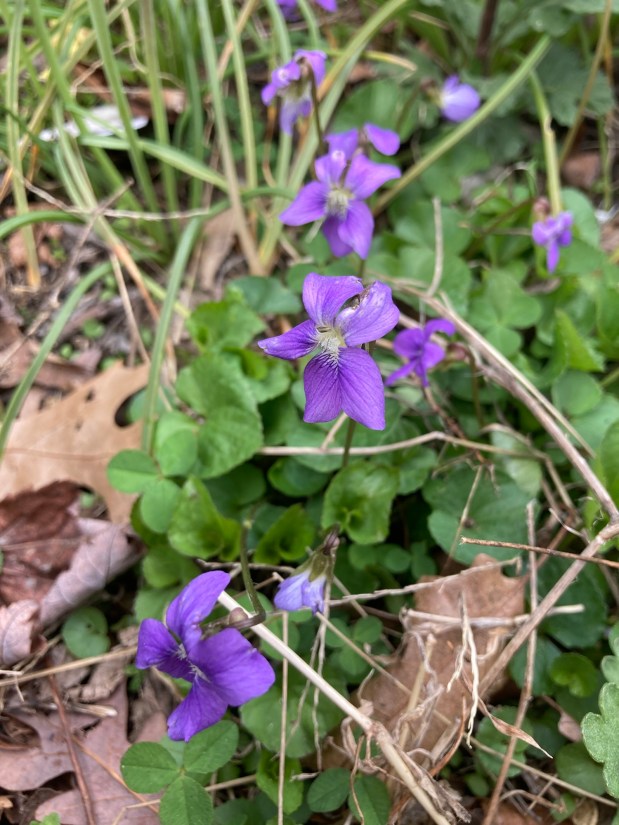
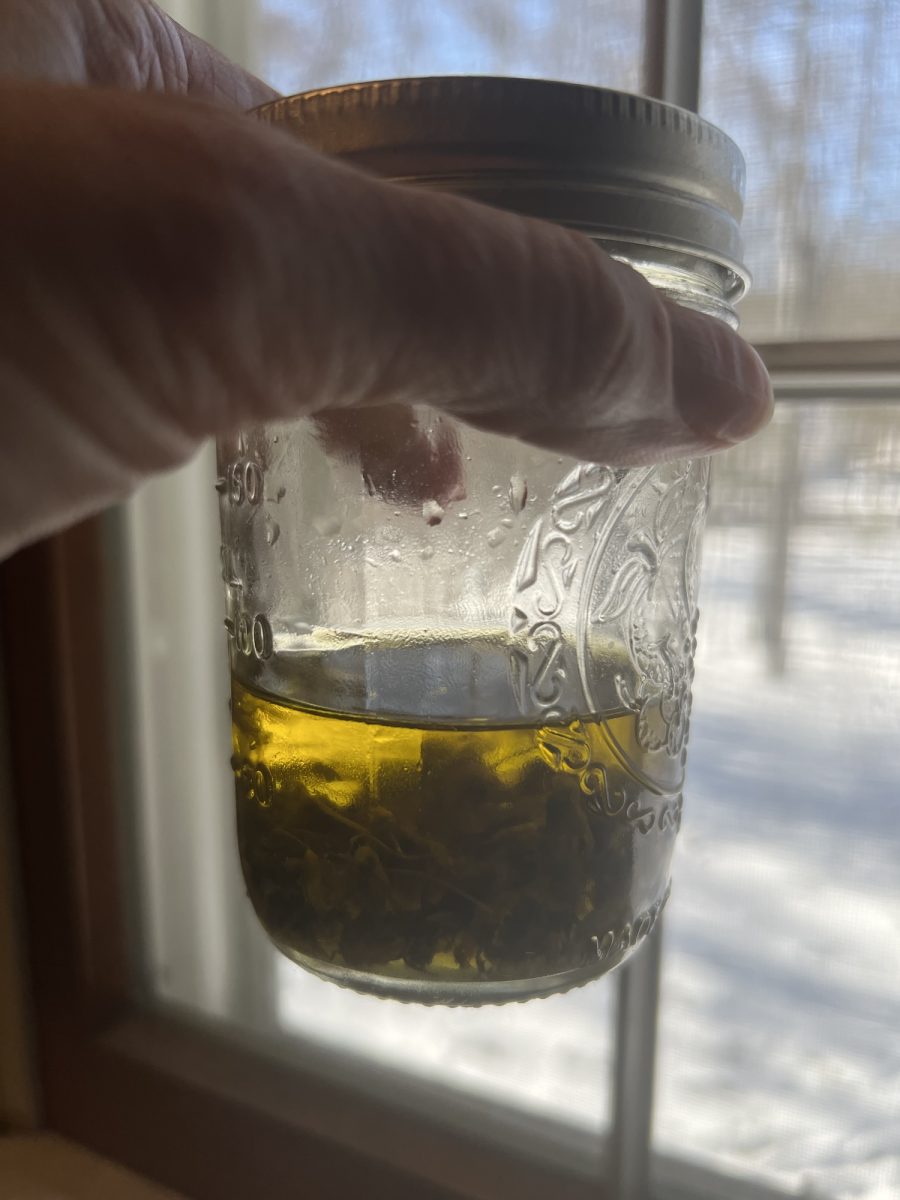
I harvest my violets from my property 2 years ago and they have a faint scent which is new to me. The smell is lovely and delicate, like sweet perfume.
How to make infused Violet Oil:
It couldn’t be easier.
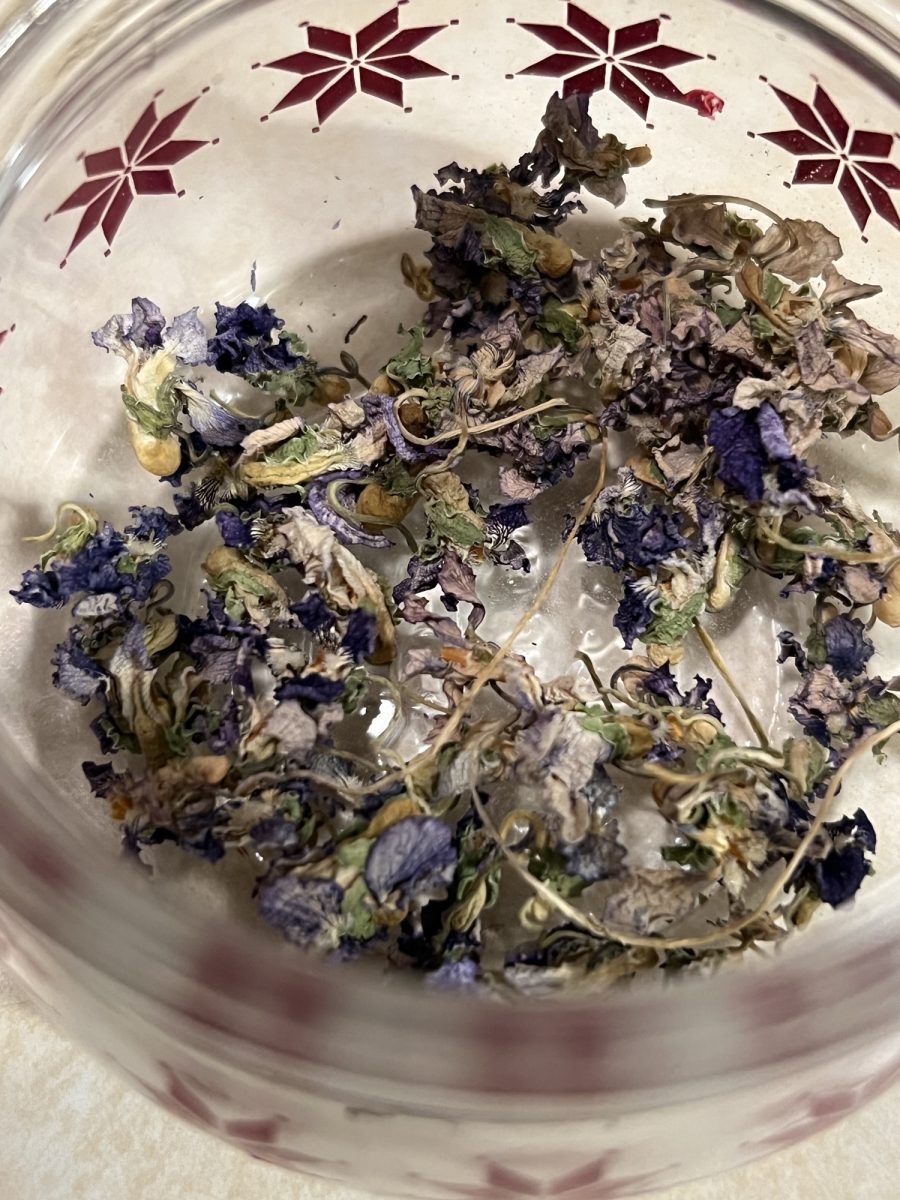
First, put some dried flowers in a jar.
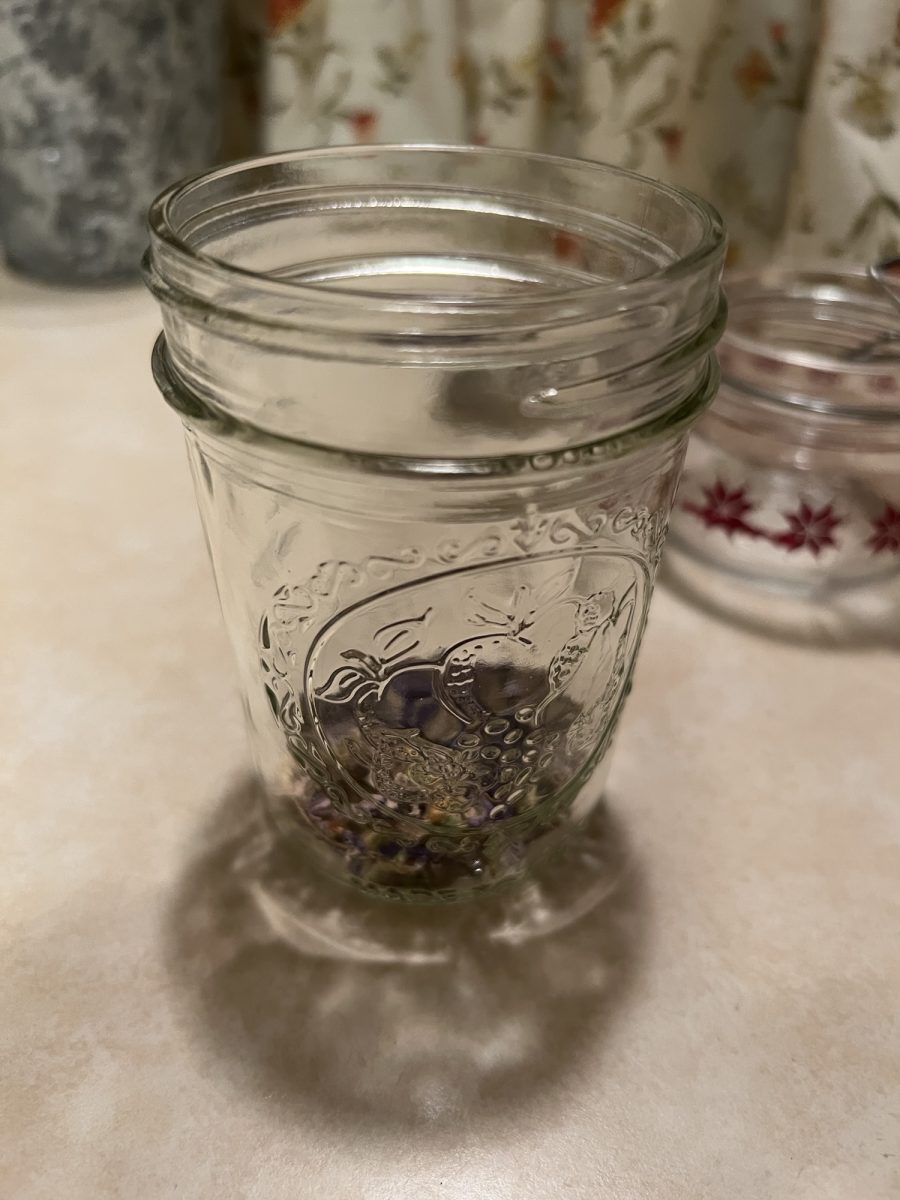
Then, cover them with olive oil (or some other oil that is liquid at room temperature).
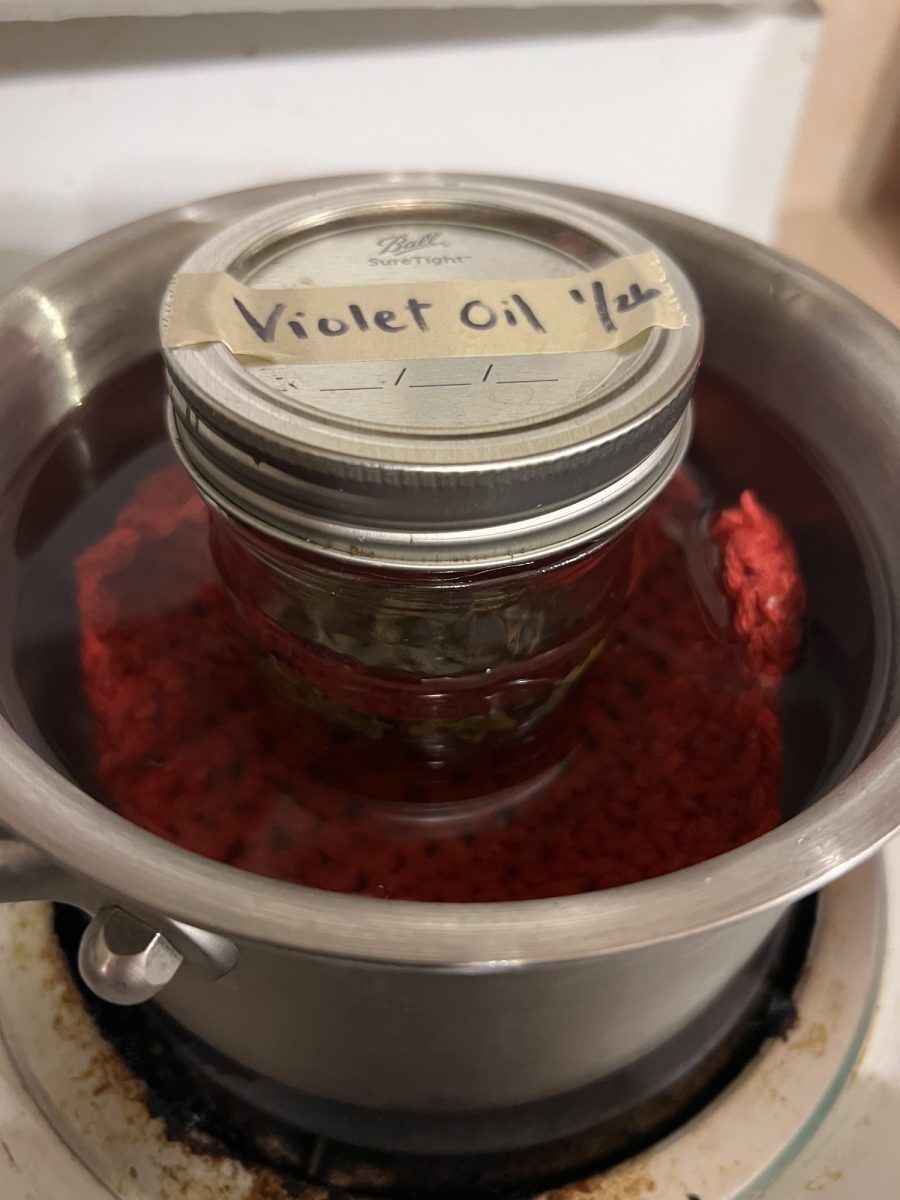
Add the sealed jar on top of a cloth to a sauce pan of gently simmering water and immediately turned the burner off.
Let it sit until it was cold. You can let it sit longer (which is what I do) or strain and use immediately.
When I rub the oil on my hands and face, I cup my hands round my nose just to breathe in and enjoy the sweet, delicate scent of the violets.
Health Benefits of Violets:
Violets act on the nervous system. They are moistening and calming, and especially good at promoting lymph flow and reducing swellings.
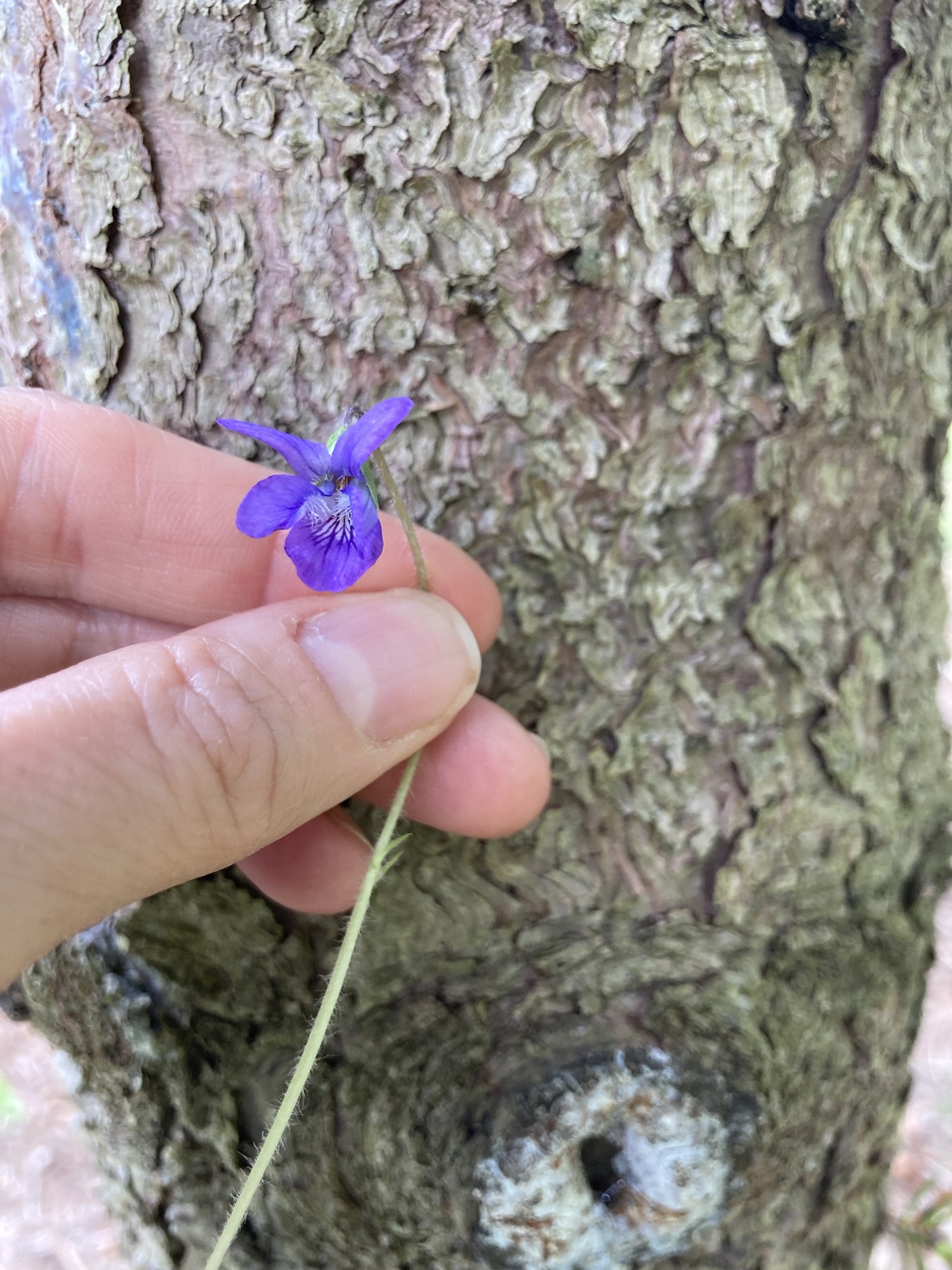
When to Harvest Wild Violets (Viola orodata and other species)
If you’d like to make your own violet oil, start watching for violets in February and March if you live in the south. The are one of the first spring bloomers. They bloom in April and May here in the Northeast.
While these flowers spread from seed, you can harvest the flowers freely because they also grow from an underground rhizome so picking all the flowers will not prevent the plant from coming back year after year.
But don’t confuse these flowers with African violets which are from a different plant family and are toxic. Be sure you are harvesting Wild Violet (Viola orodata and other species).
If you want to learn more about what to look for and harvesting these flowers, this post from our sister site, Botany in an Hour, might interest you if you want to learn how to distinguish violets from other purple flowers that bloom early like Vinca minor (periwinkle) which is also toxic.
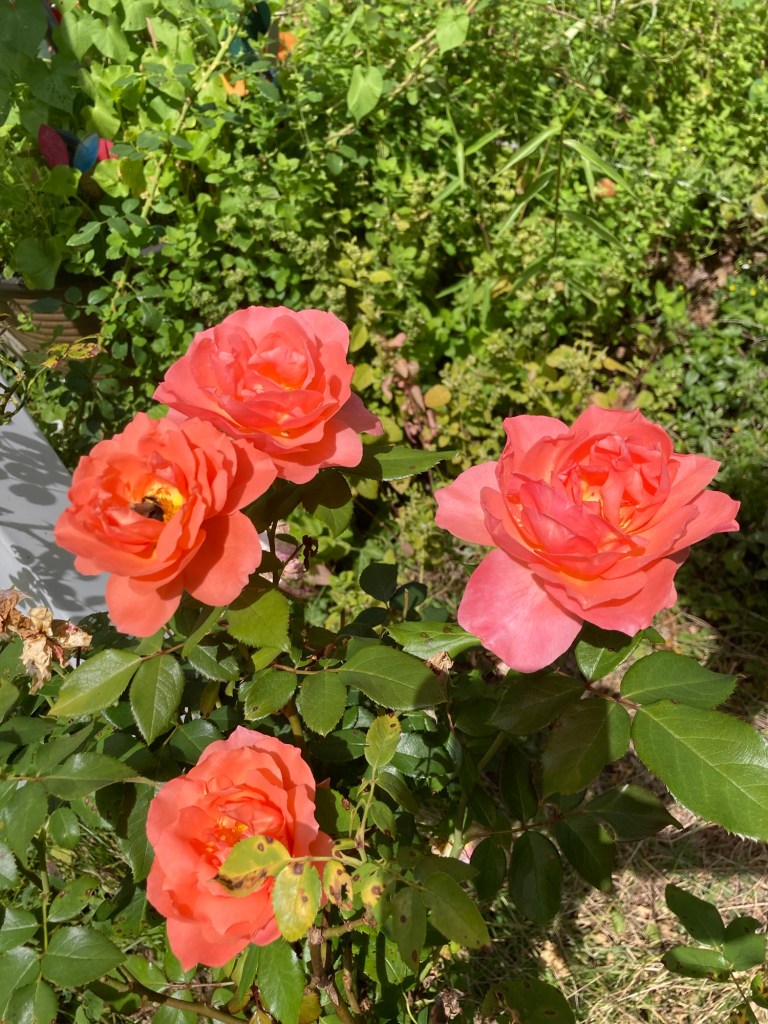
This is infused Rose oil is one my favorite things to make. I use it on my face and hands daily. 🥀
🥀 I harvest my rose petals, air dry them inside a pretty tea towel until crunchy, and store them in a clear glass jar in a dark cabinet where I can check back often to watch for condensation (a sign that they aren’t fully dry).
When I need to make more Rose oil I simply put some of my dried petals in a jar, cover them with my favorite oil (I use olive, but almond is lovely, or you can use any oil you would cook with that is liquid at room temperature), and then I sit the jar in a sunny window to add some gentle warmth.
When I need more Rose 🥀 oil, I strain the petals and pour some into a 2 ounce spray bottle for easy application.
Hint: You wouldn’t think it, but the 2 ounce travel bottles from Walmart work best. Then I can take my oil with me on the go. I have a bottle in my bag right now actually. 😊
Once strained, I store extra oil in glass jelly jars labeled with masking tape with the name and date.
🥀 Who would have thought that something so lovely and useable would come out of such a simple flower?
When my hands get dry this time of year I just take some out and squirt some into my palm. It sprays out in a nice, neat stream. Because Rose 🥀 Family plants are all astringent, Rose oil not only moisturizes, but tones my skin. And it smells as good as your Roses 🥀 do in your garden in the summer. There’s nothing like the aroma of Roses to lift your spirits when winter days are dreary.
It’s the simple ways you use your plants that make them that much more special. 🥀
Subscribe or follow on Facebook to learn how to recognize and use the plants that grow around you.
Visit our sister site, http://www.botanyinanhour.com, to learn more about your botany basics, plant recognition, and how to put your knowledge to use so that you can garden better, forage safely, harvest more, preserve easily, heal locally, and teach your kids plant skills for life.
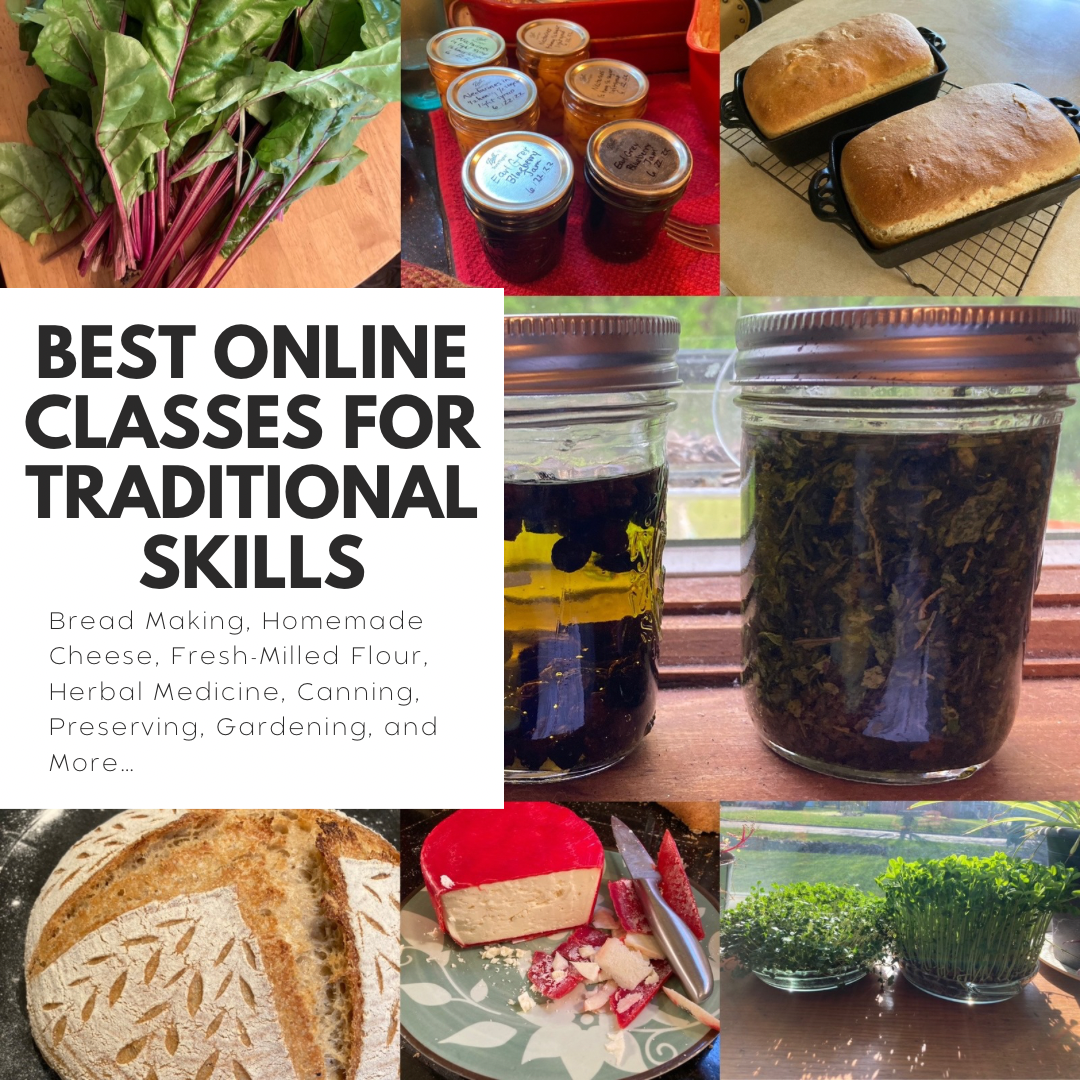
If you’ve followed my blog for any amount of time, you know that I love the classes at Homesteading Family. I’ve learned so much from them – bread making, sourdough, homemade cheese, canning. Their classes on herbal medicine, preserving, and permaculture are a great starting point if you are wanting to learn more about traditional homemade skills. The skills that our grandparents knew are becoming less commonly known, if not forgotten altogether, but they are so much more important to our daily lives as grocery prices soar and uncertainty looms around the corner. Consider these Homesteading Family Classes as a way to take back some of your independence and the skills we have lost.
Read to the end for a special coupon code! Take advantage of this discount code just for Maggie Lane subscribers!
This course covers yeast and sourdough. It is broken down step-by-step so that anyone can do it. If you’ve tried to make bread before and failed, this course is for you. By the end you’ll know just what to do to achieve the perfect loaf every time. What’s the secret? Knowing how to read the dough. The course gives you benchmarks at each step to know when your dough is ready for the next step.
Think you can’t make use of this class because you don’t have a cow? Think again. You can make all the recipes in this course using store-bought milk. Every recipe I’ve made have been made with milk from the store. The course starts out simple and builds your skills so that you can make the simplest fresh cheese all the way up to mozzarella or hard cheeses like cheddar and parmesan. No special equipment needed. You can use the things you already have in your own kitchen.
Want to learn the ins-and-outs of milling your own flour at home. This mini-course is a great companion to the Art of Homemade Bread class and gives you even more tips on using fresh-milled flour at home.
Learn how to safely water bath and pressure can in this masterclass. This comprehensive course gives you step by step instructions in over 70 lessons. You’ll get all your questions answered and learn to can with confidence. This class will remove all the doubt in eating your home-canned food.
If you have your own animals, these two classes will help you know what to do with all those eggs from your chickens and milk from your cow rather than give them to the neighbors. Learn to preserve your eggs like they are fresh for over a year, and find out how to use the good bacteria naturally present in your raw milk to your advantage.
Discover how to grow, harvest, and prepare your own herbal remedies. This beginner course is just what you need if you’ve been wanting to learn how to make your own teas, tinctures, gylcerites, syrups, herbal vinegars, oxymels, and steams, but don’t know where to start.
Learn how to work with nature in this introductory course to growing a productive and sustainable garden. Gain the basic skills you need to maximize your food production and provide your family with good home-grown food.
Gain tips on managing a busy home, homeschool, and homestead. From tips to streamline breakfast to managing your time and finding joy in your day, let this course guide you to peaceful productivity.
This digital and print magazine is a beautiful addition to your coffee table and a valuable resource to your kitchen. The kitchen is truly the hub of the home. Whether your homestead is acres of land or a tiny balcony garden, you can make use of these tips and recipes in any kitchen. Take your cooking from scratch skills up a notch. This will soon become your favorite cookbook!
Want access to all these classes and more?
Homesteading Family offers a monthly or annual membership to their Homestead Kitchen Community. Membership offers you all these classes plus access to members-only content and challenges.
Whether you’re seeking greater self-sufficiency, trying to balance the budget, or simply wanting to experience the joy of making things at home, these online courses offer guidance and experience that makes traditional skills accessible to anyone.
Special BONUS for Maggie Lane readers!
Enter your email below to get the Homesteading Family coupon code.
Calendula is one of the few plants in the Aster family that we use as my son has a allergy to ragweed which makes him sensitive to many of the plants in that same plant family.
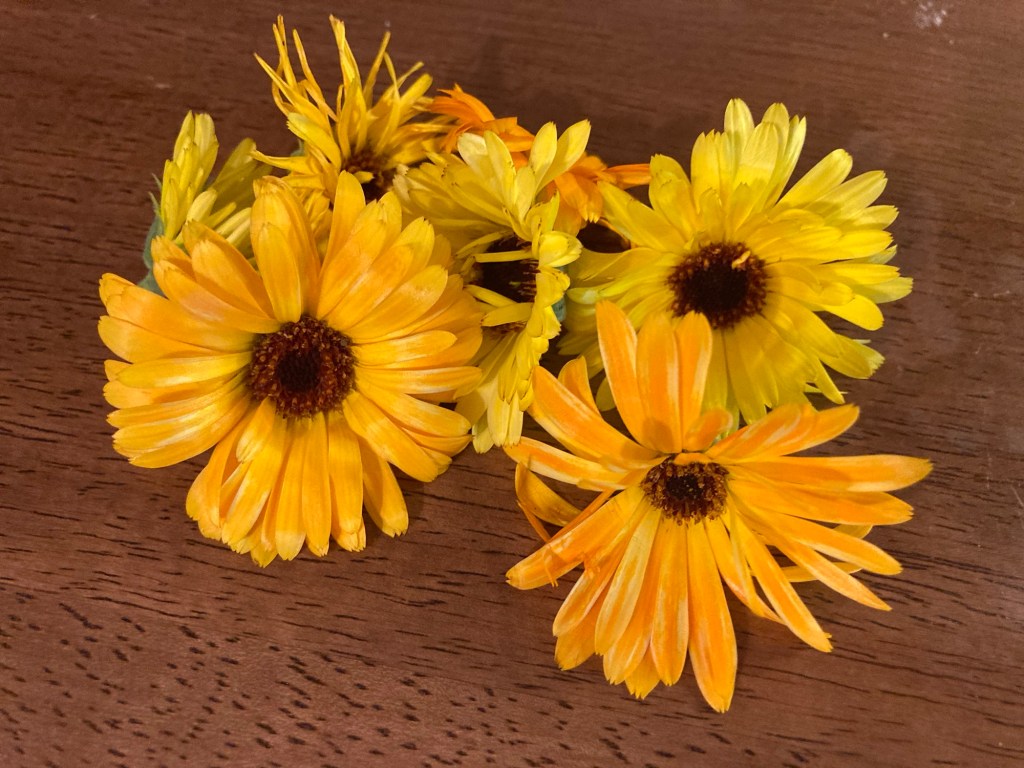
I’ve grown Calendula for years and thought I’d share how I air dry them without a dehydrator. It is often recommended that you dry calendula with a dehydrator since the centers are so thick and resinous that they can be hard to air dry, and if not completely dry, they can mold in storage.
Why this method of air drying Calendula works. Two reasons:
Good air flow.
Long drying time.
Because my calendula is grown in containers, I usually have small harvests, meaning I’m not harvesting basketfuls at a time. I might harvest 2-3 flower heads per day. This is certainly not enough to warrant pulling out the dehydrator in order to dry them.
So mine sit and wait for me, and as they wait, they dry.
Here’s what I do…
Each flower that I pick goes into a little linen bag. This is in fact a little bag for sprouting micro greens, but since I use a different method for that, I’ve never used that bag for sprouting so I turned it into my calendula drying bag. Now, let’s stop here. You don’t need a bag for this. Any airy, piece of fabric, linen, muslin, flannel, burlap, or scrap of cheesecloth that is large enough to lay the flowers on and fold over on top of them will do. The purpose of the fabric is to keep your flowers clean and free of dust while drying.
Tiny harvest. These Calendula blossoms have been drying for a few weeks.
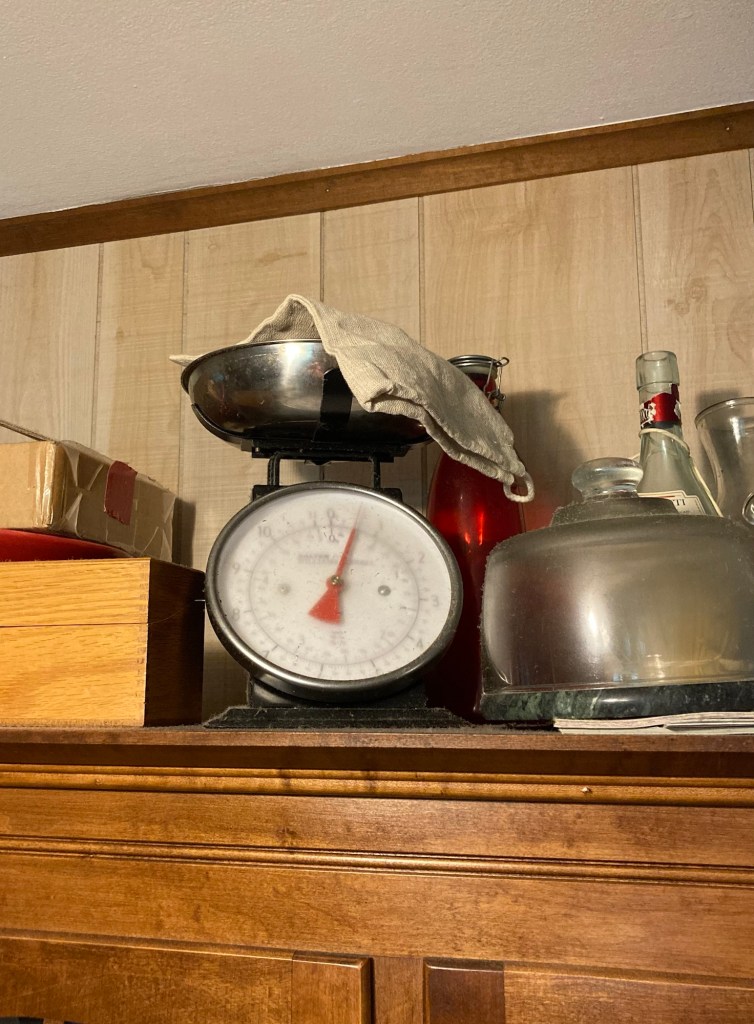
Next I lay this little bag on top of my hutch where the air is warm. I usually lay it in the bowl of my old fashioned kitchen scale which lives up here, but anywhere high and warm that is open to the air will do. On top of the fridge would work quite nicely. (Do not place anything inside an upper cupboard though. There would not be enough air flow in there.)
As I pick new flowers, I add them to the bag. Each time I take it down to add more I shuffle them around to ensure they are all getting moved around so that all the parts dry well.
New flowers added to the bag.
When I have new blooms to pick, I add the new flowers to the bag and it goes back up on the hutch. Sometime in the fall when they are all good and dry, I’ll take them down, ensure that they are all dry and can be crushed, and I’ll store them in a glass jar until I need them to make more infused oil or Calendula salve. They wait quite happily for me, and by the time I’m ready to use them in winter, they are dry and ready to use. In fact, most years, they just sit there until I remember to take them down sometime in December.
Growing, harvesting, and drying herbs doesn’t have to be a fussy process. Find a method that works and feels easy to you and go with it. What’s stopping you?
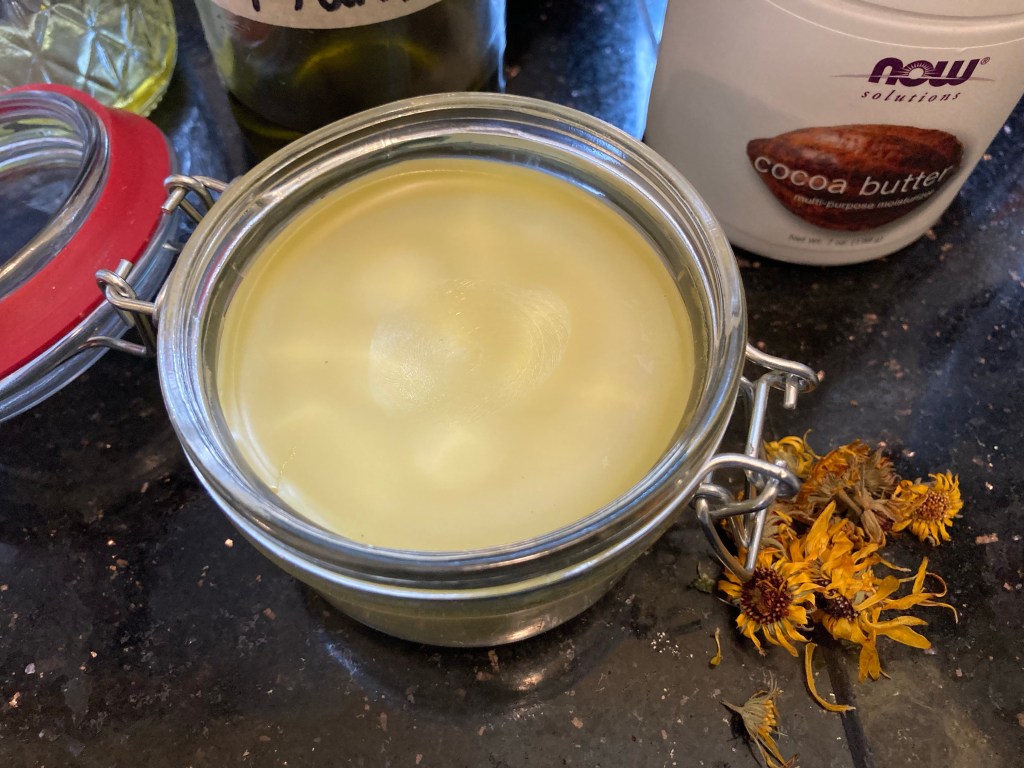
And once you have a homemade infused oil, you’re only one step away from making your own salve. You might want to check out my Healing Salve which is made with Calendula. (See the little dried up Calendula flowers laying there?) 😊
And if you really want to wrap your head around making all your own infused oils and slaves, let Carolyn with Homesteading Family hold your hand through the process. She recently came out with a Herbal Oils class that is quite nice which covers the basics of making culinary oils, infused medicinal oils, and using essential oils for your own handmade salves, balms, lip balms, and more. You can get access to it as part of their Homestead Kitchen Membership.
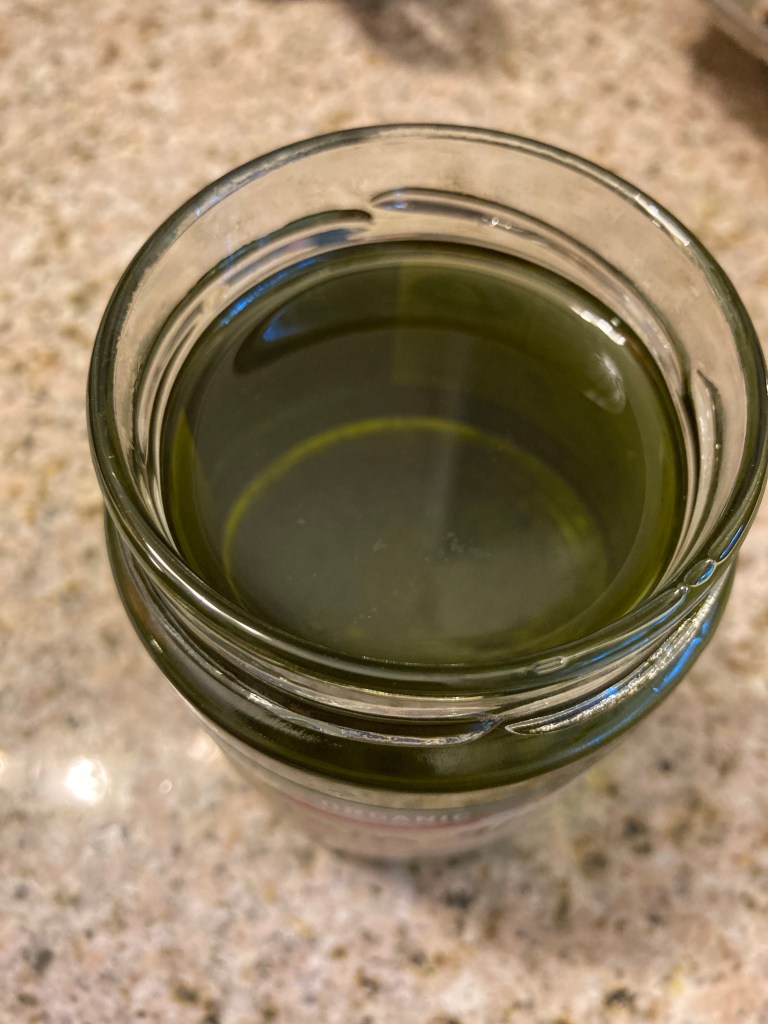
Look at that color!!! Have you ever seen a prettier dark green. Did you know that the deepness of color, indicates the potency of the oil. The deeper the color, the more potent the oil.
Note: This recipe is written for plantain but this method can be used with any plant. You could make rose, mullein, borage, Hawthorne, calendula…. The sky is the limit.
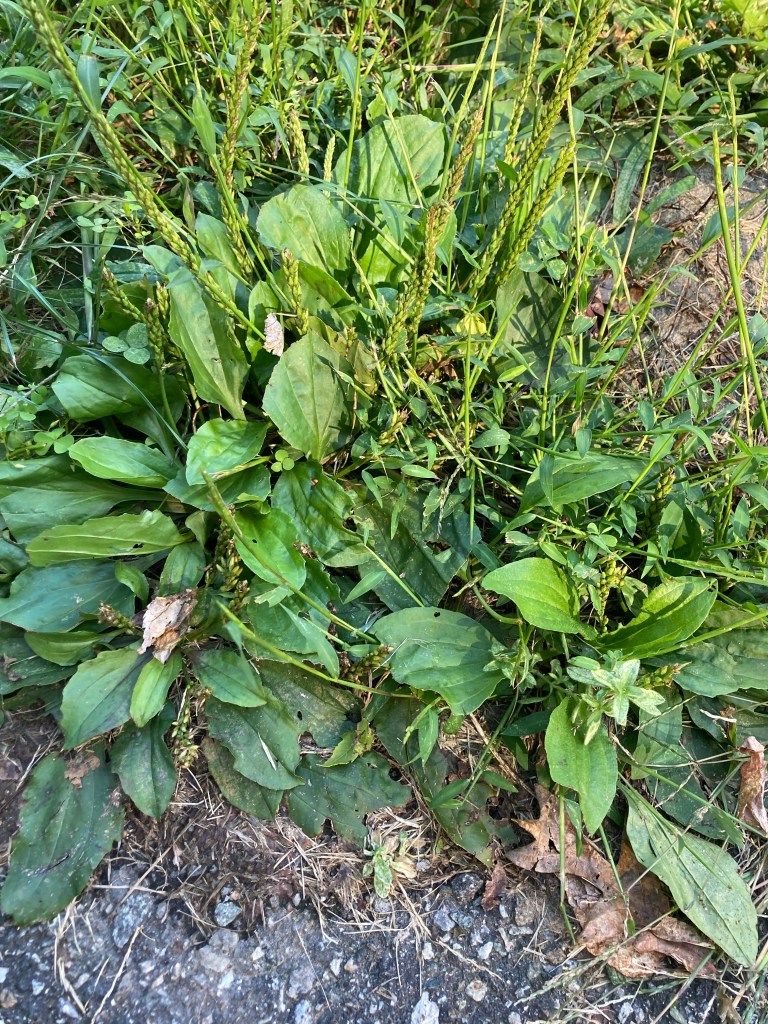
Anyone have this little plant in their back yard?
Plantain (Plantago major) is one of the most common “weeds” found in lawns. Many homeowners spend thousands of dollars every year trying to get rid of this little weed. It is a tough one to eradicate since it forms in low-growing rosettes. The fact that it hugs the ground means lawn mowers often pass right over it without doing any damage.
The other trait of plantain that makes it difficult to get rid of are all these little seed stalks that it sends up in the late summer to early fall. The seeds spread easily which means new little clusters will always pop up.
The fact that this little plant is so common and determined to survive means that it has a whole host of medicinal properties. So go find a lawn that you know is not sprayed with any weed killers, pick some leaves, and let’s make a batch of plantain oil.
Plantain leaves can be gathered any time of year when the plant is growing. The leaves will be most potent when gathered before the plant goes to seed. (Note: Do not harvest the seeds. They contain contraindications for some health conditions.)
Let’s make some oil!
Infused Plantain Oil Recipe:
Gather your leaves. Choose whole, unblemished leaves if possible. Do not pull up the whole plant. Pinch from the bottom of the leaf stalk to pick each leaf individually. This will ensure more harvests later in the season.
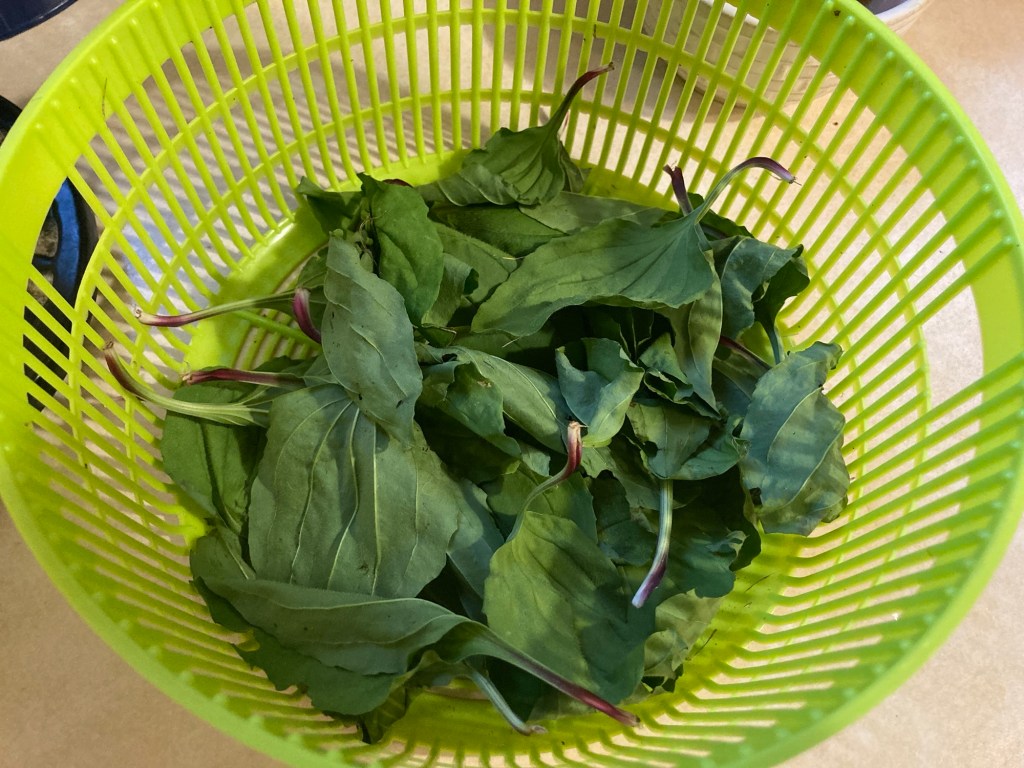
Fill a bowl with cool water to rinse the leaves of any dirt or bugs. I actually like to use my salad spinner for this step. The mesh basket makes it easy to wash, drain, and dry. See step #3 below.
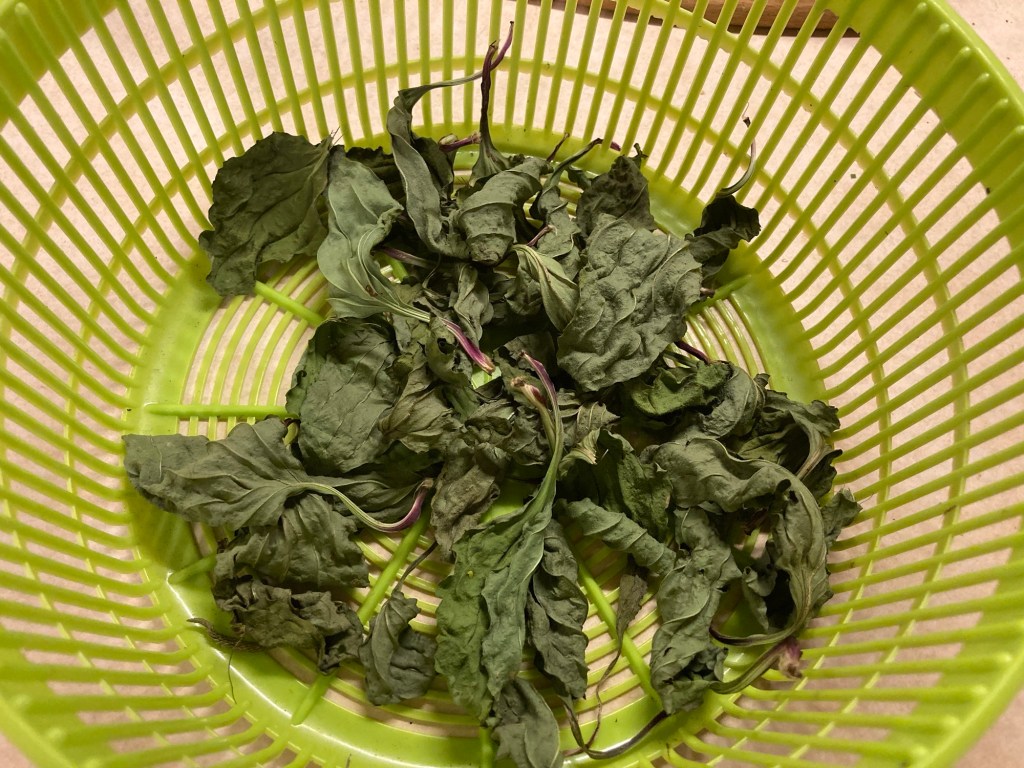
The next step is to let the leaves dry and wilt. They don’t have to dry completely, but the drier they are, the longer the shelf life of your oil will be. Using the mesh liner from your salad spinner by removing the strainer from the outer bowl so that the leaves can get good air flow works well for me. I like to fluff them up occasionally as I walk past them on the kitchen counter to keep them moving to ensure they dry evenly. Or if you don’t have a salad spinner, a pasta colander with larger holes will work as well. You can also lay the leaves out on a tea towel on top of a cookie cooling rack to air dry and wilt. Now, here, you could choose to let them air dry completely for winter storage in a glass jar, or you can wilt for 2-3 days or until dry before moving on to making your infused oil. A dehydrator could also be used in low heat if you don’t want to wait for them to air dry.
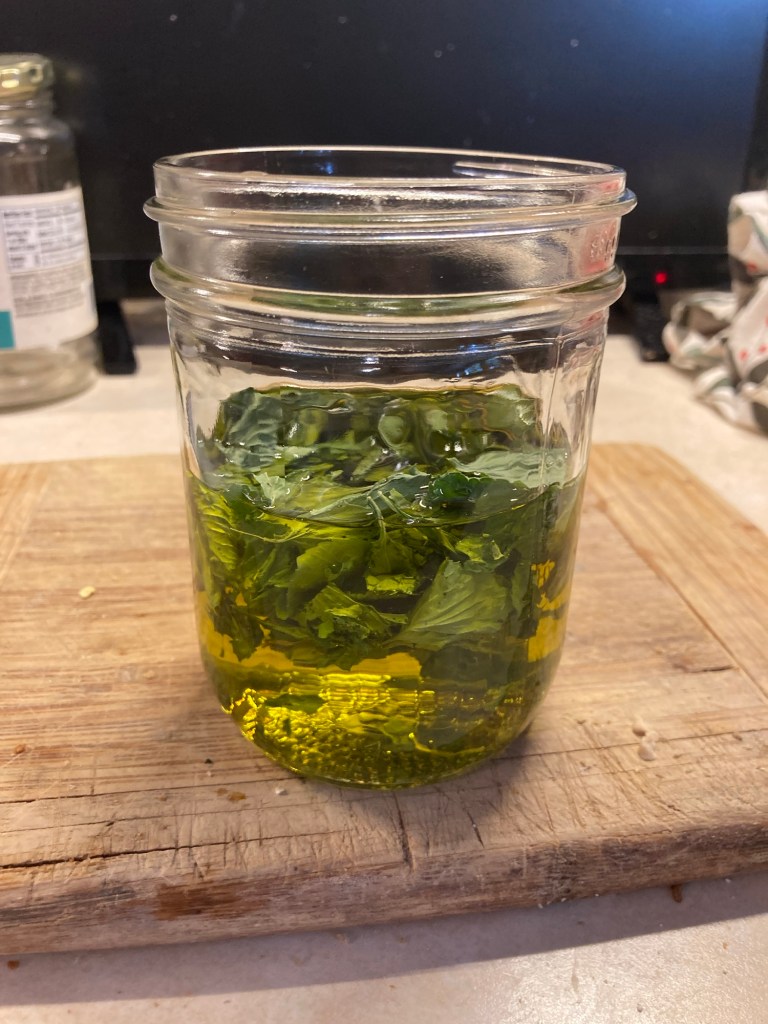
When sufficiently wilted or dried, take your leaves and roughly tear or crush them into a glass jar. Fill the jar half full with plant material.
Cover the plant material with olive oil or any oil of your choice that you have in your kitchen.
Put a lid on your jar and loosely tighten.
Set a clean dish rag or cloth in the bottom of a sauce pan that is half full of water. (Note: the dish rag prevents the glass from being too close to the heating element which could cause it to break.)
Set the jar in the sauce pan on top of the dish cloth.
Turn on the heat to medium high. (Set a timer for 10-15 minutes so you don’t forget your oil.)
Watch the oil, as soon as the water starts simmering, turn the heat off. We don’t want to cook the plant material. Just infuse it with a little warmth.
Let the jar sit until it is cold.
Strain your oil using a handheld mesh strainer (often the dollar store or grocery store will have these) into a clean, completely dry, glass jar.
Label your jar with the name of the oil and date. Masking tape and a sharpie works well for this. I keep a masking tape dispenser like this on my kitchen counter specifically for labeling things.
And you did it! You made your own Plantain oil! Well done!
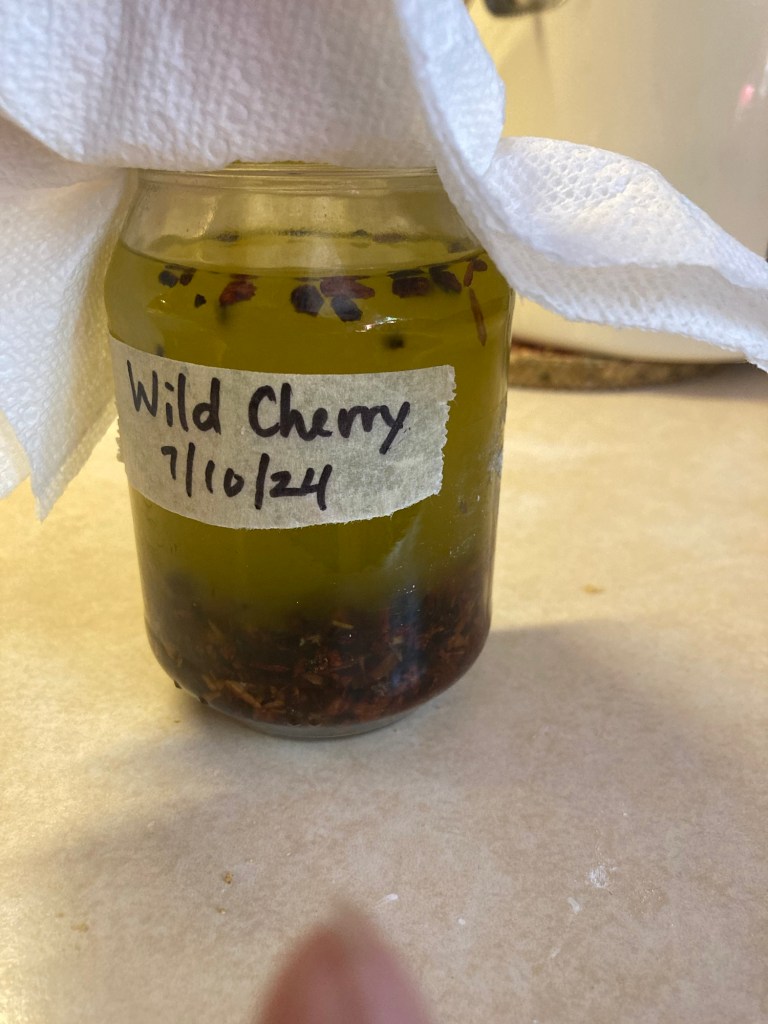
And now that you have the skill of making an infused oil under your belt, you can do it with any medicinal herb. Be creative. Some of my favorite plants to make oil with are mullein, rose, calendula, Pansy, violet, echinacea, pine, wild cherry, and yarrow. I use my infused oils every day.
Want to see a photo log of these steps? Scroll to the bottom of the page.
Infused Oil FAQ Section:
What is infused plantain oil good for?
Plantain is an excellent remedy for any type of bite, sting, or skin irritation. It is especially useful for anything that needs pulling or drawing out. It is a mild astringent and good for any skin or issue with any angry or inflamed membranes.
How long will my infused oil last?
Homemade infused oils are good indefinitely if made with dry plant material, and if stored in a cool, dry location. If fresh or wilted plant material is used, extra steps will need to be taken to ensure that your oil doesn’t mold.
What are the signs of moisture in my oil?
Condensation or cloudiness on the inside of the jar after straining is an indication of moisture. This is easy to remedy. Simply take the lid off of your jar and cover with a paper towel or coffee filter and secure with a rubber band. Let the jar sit until the oil is clear and all the moisture has evaporated. Then you can replace the lid and store in a cool, dry place.
Do you see the cloudiness in this jar of oil?Same jar of oil as above after 2-3 days sitting with a paper towel cover to allow the oil to evaporate. Can you see how much more clear the oil has become?
How do I know if my oil is moldy?
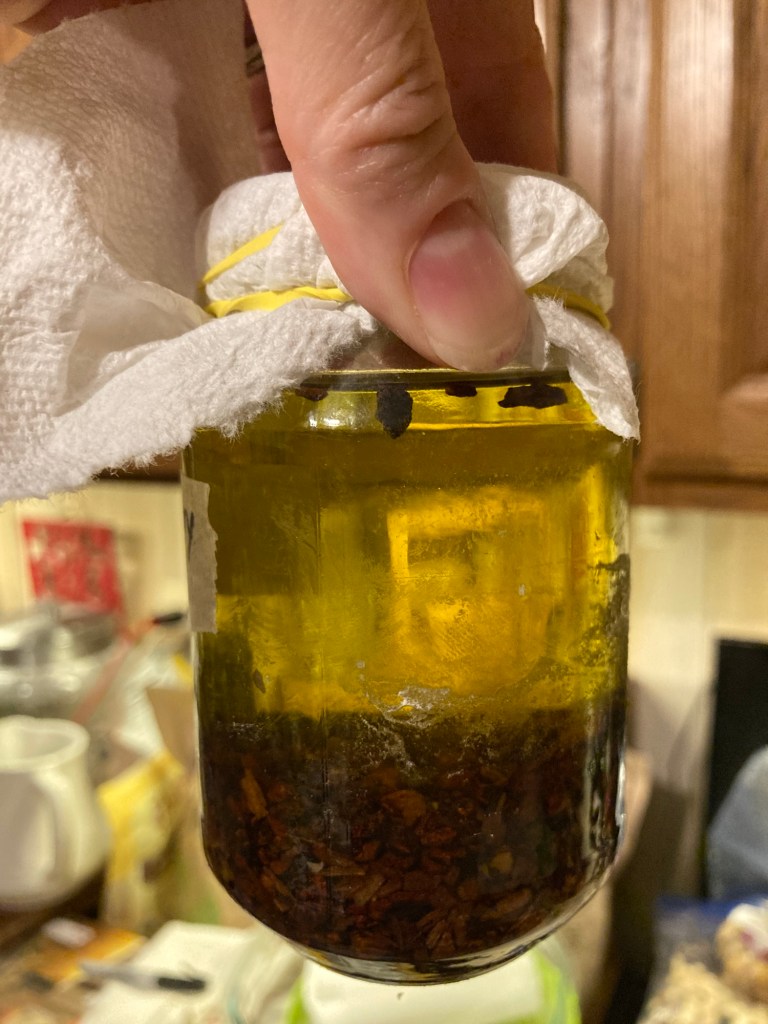
When an infused oil grows mold, it often does not grow on the surface like what we are used to seeing on food in our fridge. It grows down inside the oil and looks like dark fuzzy spots floating in the bottom of your jar. For this reason, I like to store my oils in clear, glass jars so that I can easily see if anything begins to grow or look amiss. An off smelling oil would be another indicator. However, be sure that you smell your oils right after making them to be sure that you know the scent of that plant. Not every plant has a pleasant smell, and you don’t want to throw out a perfectly good batch of oil simply because you aren’t familiar with the scent of that particular plant. So train your nose to know what your oil smells like right after you make it.
How to know if my oil has gone bad?
Visible mold on the surface, dark spots growing in the bottom of the jar, or rancid or putrid smells are signs that your oil has spoiled and should be discarded.
Can I use this same method to make an infused oil with a different plant?
Yes! This method can be used to make an infused oil with any medicinal plant. Keep in mind that infused oils dried plant material will have the longest shelf life.
Do you feel confident to make your own infused oil now? I hope so. Enjoy your creations. Using my oils through the year and especially during the winter is one of my favorite things.
Want to make your infused plantain oil into a salve?
Make this Healing Salve using your infused plantain oil. If you don’t have infused Calendula oil, just replace it with an extra part of plantain oil and you’ll be all set.
Healing Salve
Want to take a deeper dive into the world or herbal oils?
Consider the new Herbal Oils class by Homesteading Family. It covers making your own culinary oils, medicinal infused oils, as well as your own salves and body products using essential oils. It’s a great all-in-one course for beginners. You can get access through Homesteading Family’s Homestead Kitchen Membership.
Photo Log Step-by-Step of Making an Infused Plantain Oil:
Plantain (Plantago major) – freshly picked.Washed in my salad spinner.Air dried and wilted.Completely dry and crispy. These can be stored for use later in a sealed glass jar, or you can move straight into making your infused oil.Though not plantain here (this is torn violet leaf), the next step is to roughly tear your plant and place in your jar. Cover the plant material with the oil of your choice. Place the jar on a cloth in a sauce pan half full of water. Turn on the heat.When the water starts to simmer, turn off the heat and let it sit until completely cool. Then you’re ready to strain and store.
Note: Some links on this page are affiliate links.
I’m working on updating my herbal first aid kit. We are undertaking new to us adventures at our new property – chopping wood, building garden beds and playhouses, cutting limbs, etc. Since these activities have the potential for new injuries, I figured I should need up my first aid supplies. But I’ll post more about that later.
I have a collection of herbal oils at the ready (see photo above). The one I use the most in first aid situations is an essential oil blend we like to call Tiny Oil. I’ve used it since mine kids were babies for soothing and disinfecting scrapes, bites, and stings. You can find the recipe on the Homemade Baby Products Page. This is a great natural alternative to over the counter antibiotic ointment.
But, in pondering what else I would need in my herbal first aid kit, I was reminded not to discount some of the most basic things that I already have on hand. Primarily, using cloth as a bandage. 🤕
I encountered two instances recently for which I found cloth to be preferable to standard bandaids or bandages.
Plantain – Plantago Major
The first was a bite that I had right under my hair line that healed over on the top but still was puffy underneath. I wanted put plantain on it as well but I couldn’t put a bandaid on without pulling my hair out when it was time to take it off. Enter my cute little cloth headband. It holds the plantain in place and is fashionable at the same time. 😉
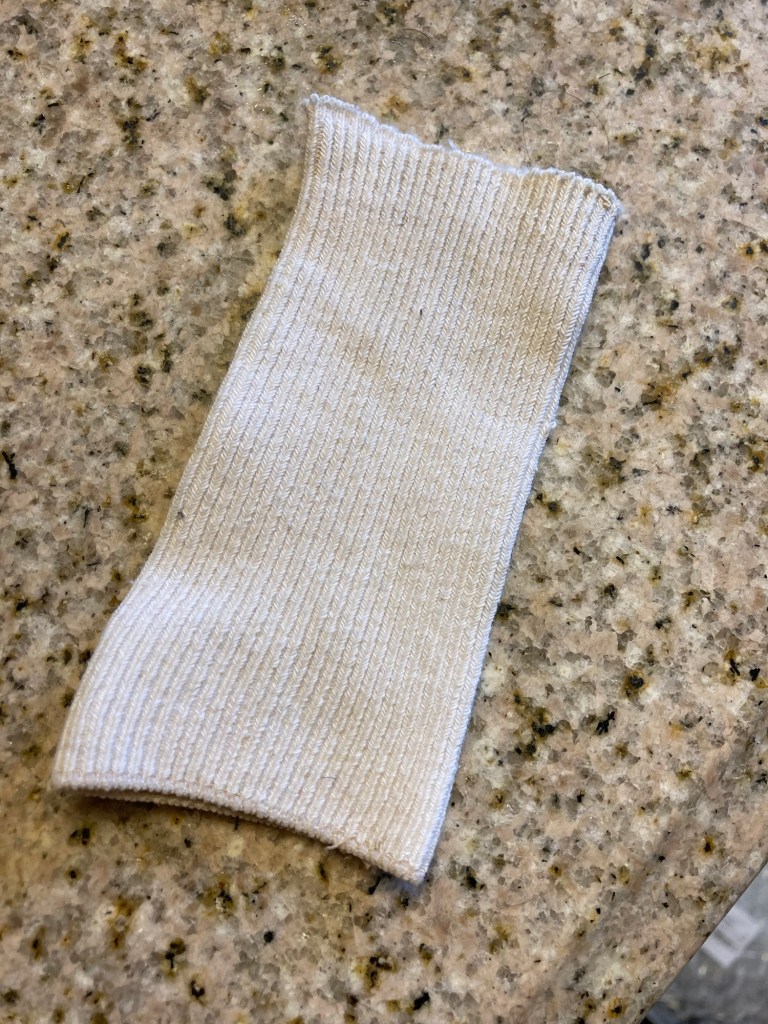
The second instance was realizing that my youngest child is very allergic to the adhesive on bandaids. 🩹I guess I don’t use them on her often. I used one to put some plantain on an old bite that she had that had gotten inflamed. Well, the bite got better, but now she has welts from the bandaid. 😞 Enter cotton baby socks. You know, all those little socks that the washing machine eats. Save them. They make excellent cloth bandages for little arms, wrists, and ankles.
Cut the cuffs off all those orphaned baby socks and add them to your first aid supplies. If you fold them over, it makes a little pocket where you can tuck loose herbs in to apply to bites, cuts, or stings.
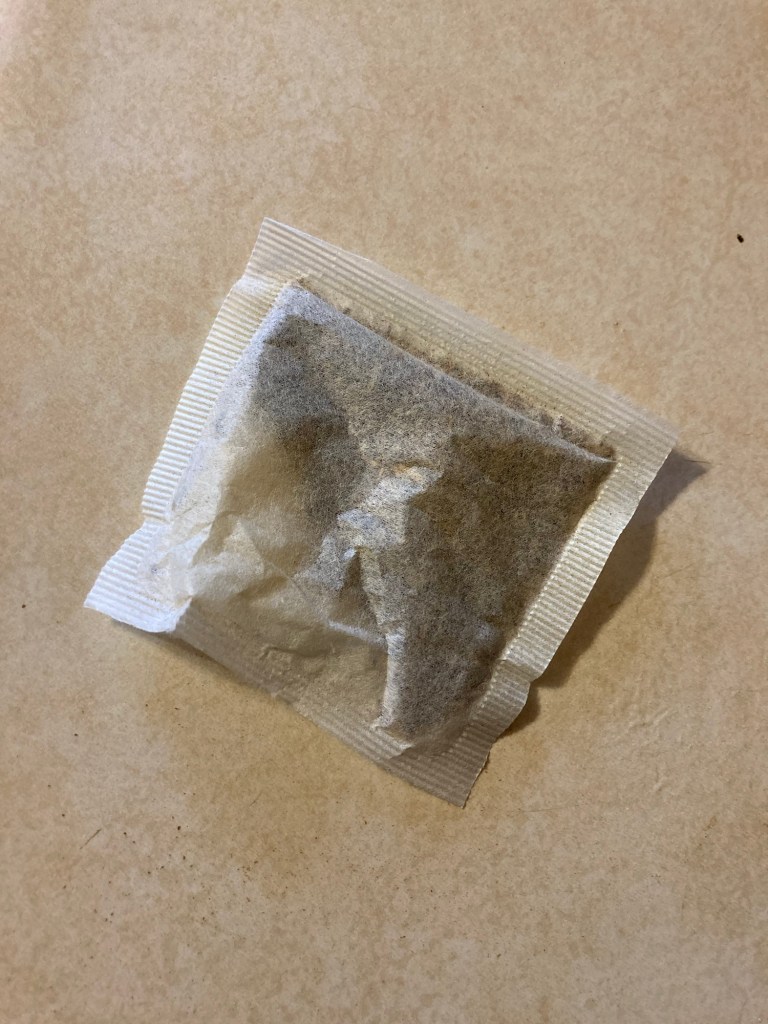
And lastly, the best remedy I’ve used for inflamed bites and stings you probably already have in your kitchen cabinet – herbal tea bags! ☕️ I’ve used this for years on my kids and it works wonders. Apply it when it is comfortably hot directly to the skin and leave until cold. The moist heat pulls out the toxins and reduces swelling. And the cuffs of those little baby socks are great for holding tea bags, plantain, or any other herb on a little person who won’t hold still, or they work if you are a grown up as well. 😊
Stay tuned for more. I’ll be posting about my Herbal First Aid kit as it comes together.
I taught a group of 1st-3rd graders how to make this salve yesterday. If they can do it, you can too.
This takes an otherwise silky, moisturizing salve and bumps it up a notch with the healing powers of calendula and plantain. Both are excellent for your healing everyday cuts, scratches, and scrapes, but I have found calendula to be excellent at healing infected or hard to heal wounds, and plantain to be excellent for eczema that is easily irritated by other oils and lotions.
Healing Salve Recipe:
1 part infused plantain oil
1 part infused calendula oil
2 parts beeswax
1 part cocoa or Shea butter
1/2 part lanolin
5-10 drops of essential oil for scent (optional)
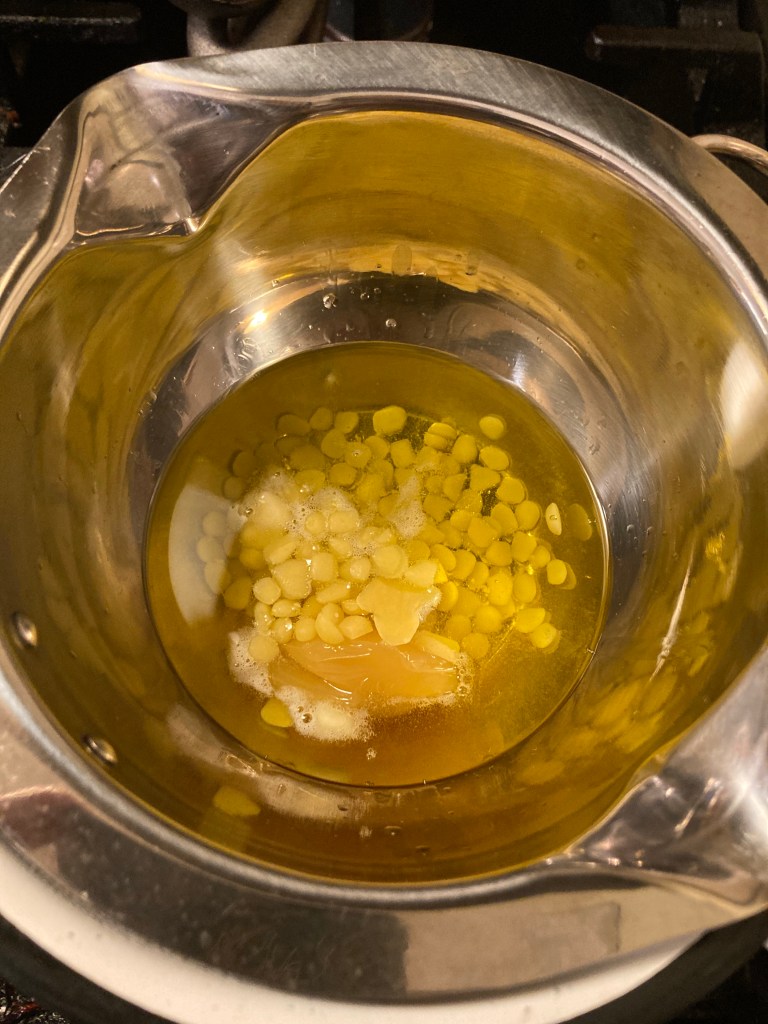
Melt all the ingredients in a double boiler. Pour into a heat proof container. It’s that simple.
When I made it with my group of girls, we did some as chapsticks too, because what little girl doesn’t like her own chapstick. We also poured some in a jar to use as salve.
If you don’t know how to make an infused oil, refer to my post on making your own garlic oil, and simply sub calendula flowers and plantain for the garlic in the instructions.
You can also skip the infused oil and use plain olive or almond oil if you prefer to have the moisturizing properties for everyday use without the healing powers of calendula and plantain.
Want to take your knowledge ofherbs and home remedies up a notch?
This book is newer to me. It includes some herbs that my other books do not have listed that I wanted to study. I haven’t delved too deeply into it but it is a lovely book.
Technical Resources:
These are more technical and get into the more medical side is using herbs.
This is a link to my online Botany class which includes learning to ID plants by plant family.
Last but not least, write your own book…
Keep your own notes on each herb and ailment you study by creating your own book. I use an old address book that has alphabetical sections. I write the name of the herb or ailment alphabetically and make notes of what I learn about it.
Not sure where to go from to increase your knowledge of herbs and home remedies?
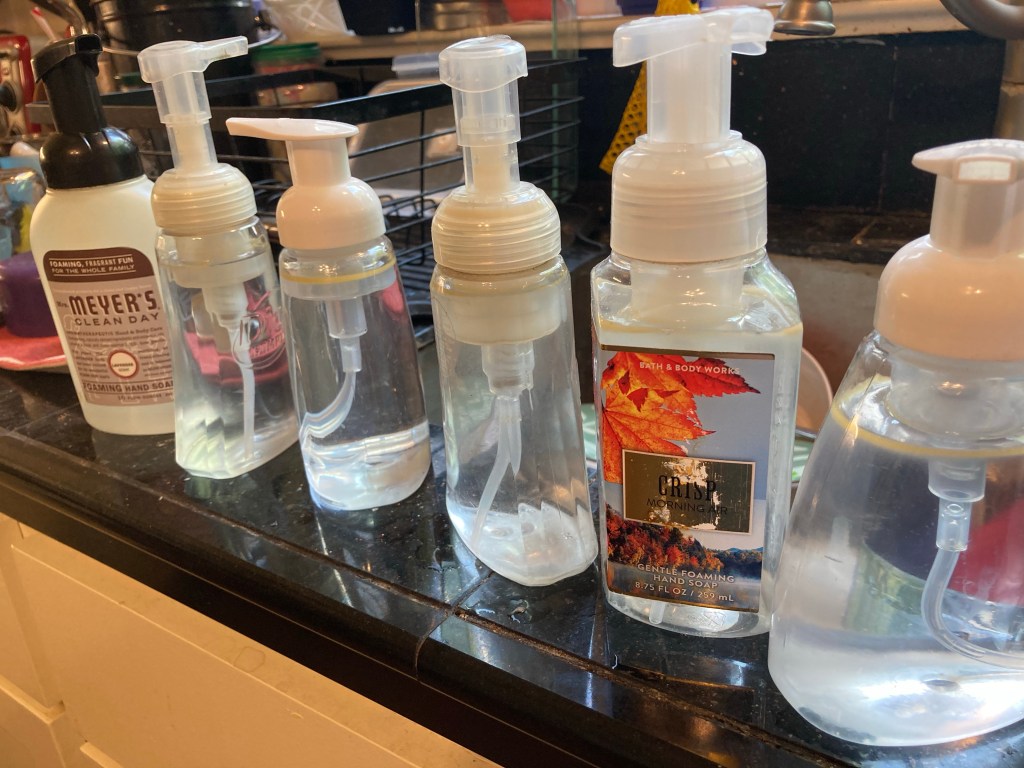
Anyone else going through hand soap like there is no tomorrow? Between doing more as things recipe from COVID, and getting dirty playing outside it seems like we are running out of hand soap every time I turn around. I’m glad it only costs me pennies to make more rather than $3 a bottle. We’ve saved thousands over the years by making our own soap. It works great, and feels like the expensive brands you buy at the mall.
DIY Foaming Hand Soap:
In a foaming soap pump, add the following:
1 tbsp of your favorite dish soap
8-15 drops of your favorite essential oils
1 tbsp aloe gel (optional but makes it feel silky smooth)
Fill with water, and shake!
And you’re done! And it cost you about .03 to make rather than $3.
On another money saving note, you can buy empty foaming soap pumps on Amazon, but in my experience, those don’t last and stop working after a couple of months. The best I’ve found are the Dial foaming soaps at the grocery store. I buy the pumps, use the soap in them, and fill them up again. I’ve had some of them for years. They really work great.
Want to makemore of your own homemade products?
Homesteading Family’s Handmade Home course covers soapmaking with recipes for dish soap and a myriad of different bar soaps, as well as making your own herbal oils and salves. You can get access it through the Homestead Kitchen Community. To see all the classes that Homesteading Family has to offer, click here and then click on the Homesteading Family logo at the bottom of the page.
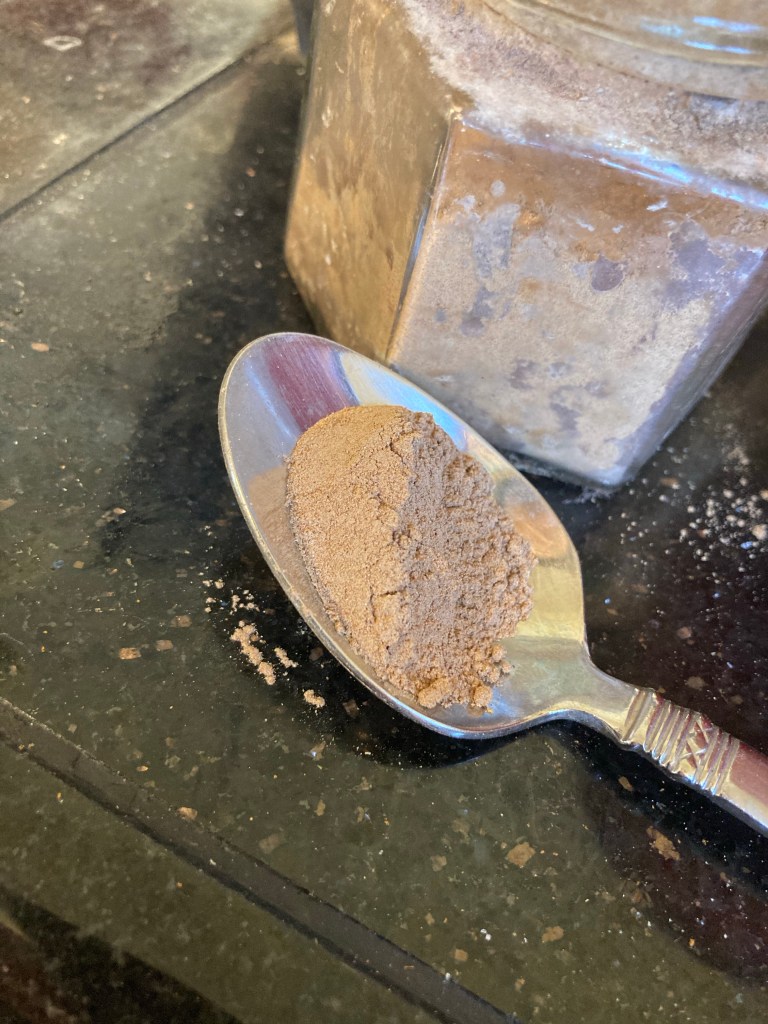
This couldn’t be easier to mix and is a great option for people that can’t use regular toothpastes due to ingredients like vegetable glycerin which can be a problem for people with coconut allergies. Ready for the recipe? Here you go….
Cinnamon Spice Tooth Powder:
In a small jar mix the following…
2 tbls Bentonite clay
2 tbls cinnamon oowder
1/4 tsp sea salt
1/8 tsp cloves
I put them all my little jar and shake, shake, shake to mix.
I have tried many versions of this recipe over the years, from powders to pastes, but this has been our go tooth powder for the last several years. As long as it is kept dry, it’s shelf life is indefinite. And I find it very effective. The Bentonite clay pulls toxins, cinnamon and clove add flavor and disinfect, and the salt adds to the disinfecting properties as well.
Apply to your toothbrush using a popsicle stick or tiny measuring spoon for best results.
I’ve chosen to use lots of reusable cloth products over the years – cloth napkins, cloth diapers, and mama cloth. At the beginning of COVID, I had to come up with a cloth alternative for paper towels when all the regular paper towel were out of stock. I ended up using something I already had. I raided my cloth diaper bins and pulled out our cloth baby wipes. I’m so glad I did. We’ve probably cut our paper towel usage by more than half. I still keep paper towels on hand for extremely greasy or germ-filled cleanups. But for the messy faces and daily spills, these work great for us. Read on….
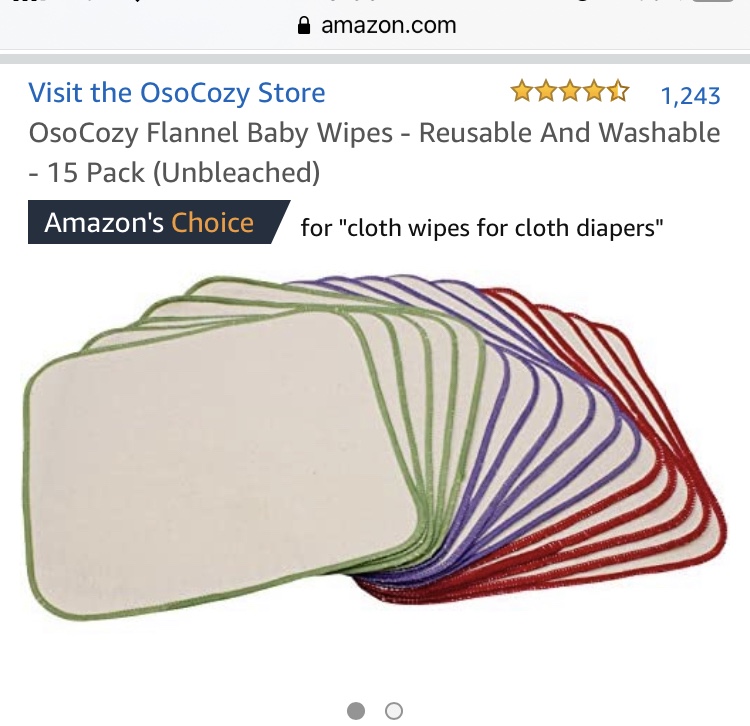
Many companies offer various different reusable paper towels these days to help people reduce their use of disposable paper products. I tried some of them. But, honestly, the flannel baby wipes we used when we did cloth diapers with our kids, are the best washable cloths that I’ve found.
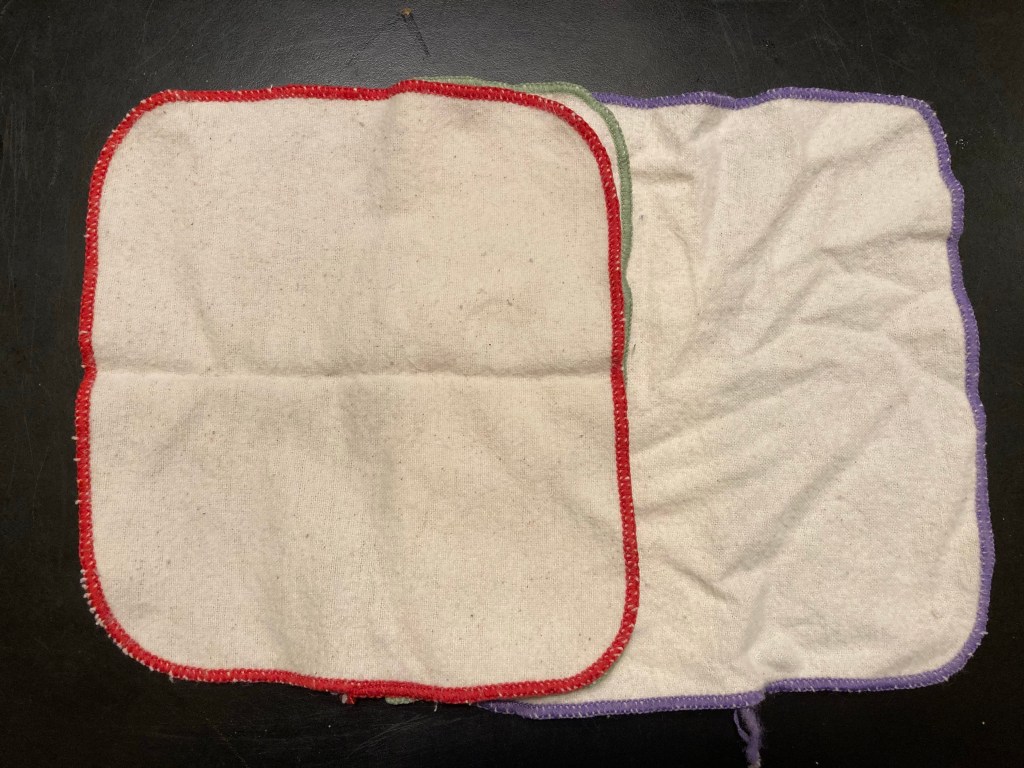
They are small, soft, and absorbent. I keep a tissue box cover full of them on the kitchen counter with them all folded over tissue style so that the kids can pull them out easily. They are just the right size for what the kids need. I keep a bin in the Butler’s Pantry for dirty towels. The kids throw them in there and they get washed with all the kitchen laundry.
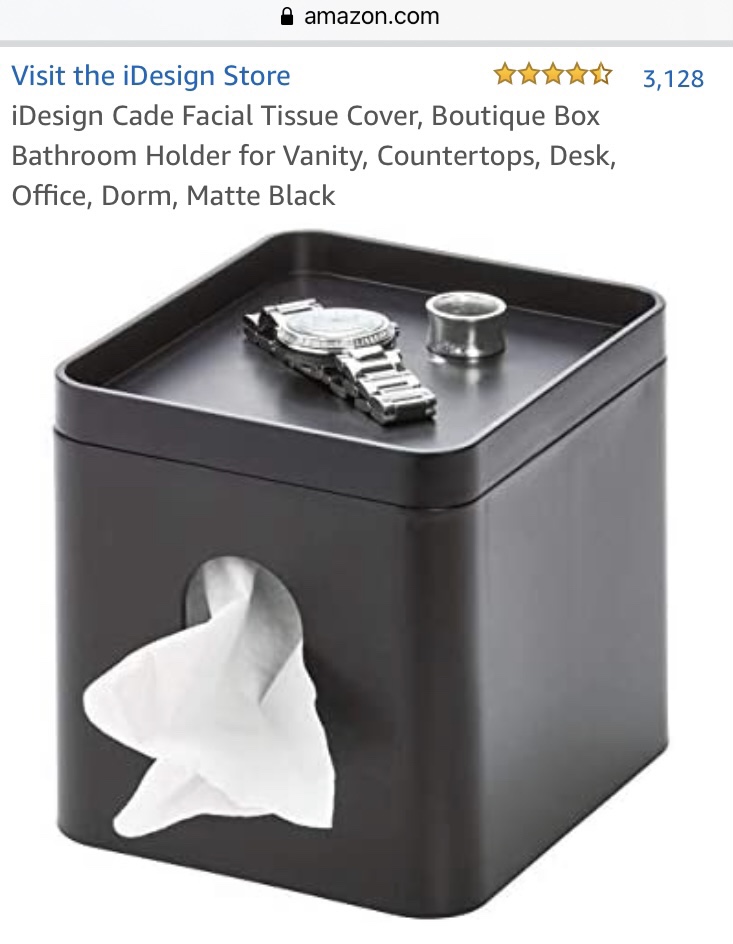
I keep this tissue box cover on my kitchen counter for the kids to grab flannel wipes from when they need to wipe a messy face or clean up a spill. This makes convenient so they reach for the cloth wipes rather than a paper towel.How to fold tissue style. 1) Purple wipe goes down first. 2) Green wipe covers half of purple wipe. 3) Red wipe covers green wipe.4) Fold purple wipe over red and green edges. 5) Repeat process by laying another wipe on top of the purple. 6) Fold the Red over. 7) Go again until all are folded. 8) Place in your tissue box.
I like this Tissue Box Cover best. It works great on the kitchen counter and looks nice. I like that I can set things on top.
You could also easily make reusable wipes for this purpose using an old flannel shirt or pajama pants. I have some saved for just this purpose. I’ll get around to it someday. In the meantime, these work well for me.
Jump in and make your own. It would be a great upcycle project. Break out the scissors and sewing machine, or give some purchased wipes a try.
It certainly has saved us lots of paper towels each week.
* Note: There are no affiliate links in this post.



















 Remembering Maggie Lane