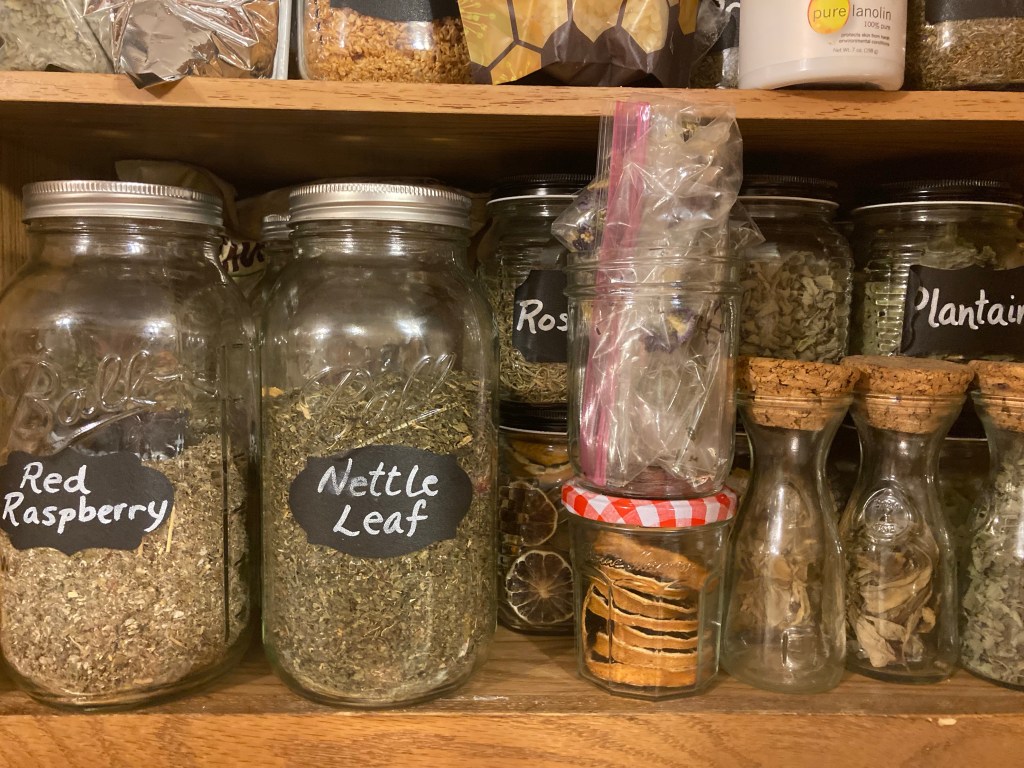
There’s something satisfying about having all you brews, infusions, and concoctions ready and within arms reach when you need them.
We moved to a new house this summer. I finally got around to opening up my box of herbal remedies this week. I hope to unpack it soon and get it all nicely arranged on the shelves with my other herbs.
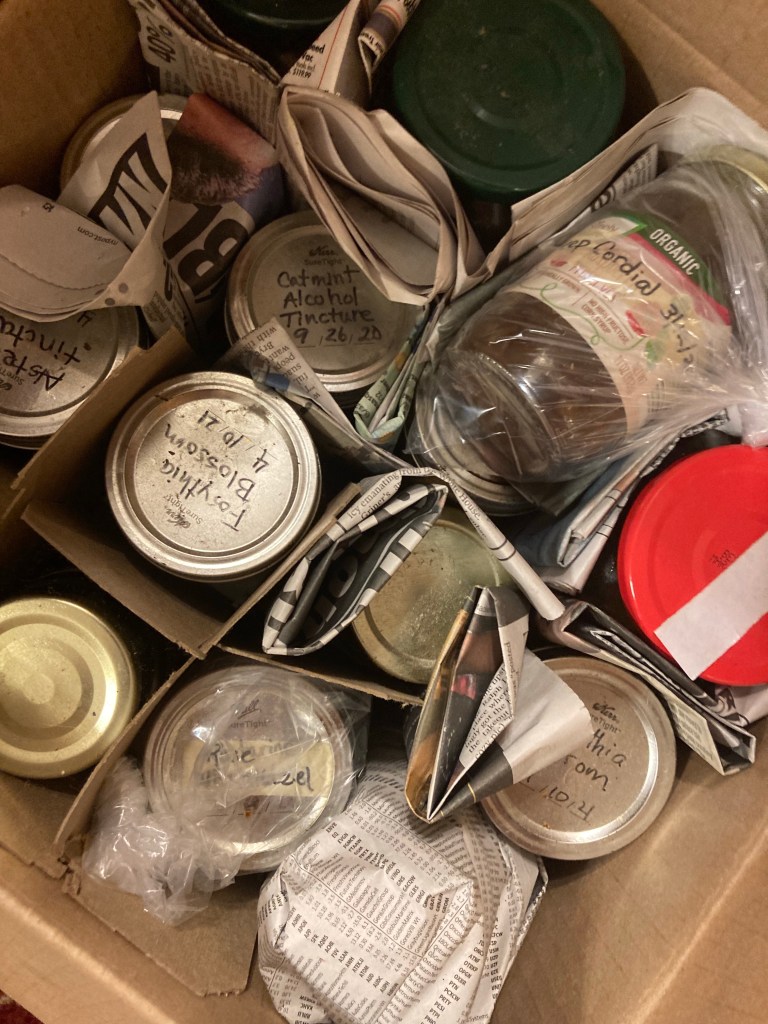
I haven’t made anything new this year except a new batch of mullein oil from last year’s leaves. I need to re-establish all my medicinal plants here at the new house so I don’t have much to harvest yet. And there is no mullein growing here if you can believe that. I was so jealous on the way to PA this summer as it was growing all over the roadsides. It was all I could do to keep from asking my husband to pull over so I could jump out of the car to grab some. I’m going to have to plant some I guess.
I also need to pull out my favorite local medical plant ID book and investigate what is actually growing here at the new place. There’s got to be some good stuff in the woods behind our house. So far I’ve found some plantain and yarrow in the front yard, but I haven’t investigated the woods yet. One thing at a time. Trying to get the inside of the house live-able and settled. The outside will have to wait for now.
Do plants have personalities?
Making your own remedies either from herbs you grow and harvest yourself or from dried herbs that you buy requires you to get to know the herbs. I like to think of them as friends who can help me when I’m in a time of need, but first I have to get to know their personality so that I know what they have to offer. Reading and studying about them is helpful, but rather than solely focusing on the medical conditions that an herb may help, I file my herbal friends away in my address book describing their characteristics. This way I get to know the “personality” of the herb.

This is a little address book that I’ve had for years. I use it to make notes on herbs or conditions that I’m reading and researching. Since the address book is organized alphabetically, I use the lines where you would typically write a person’s name and contact information instead to write the name of the herb or condition that I’m researching and then I use the extra lines to make notes of what I’m learning. That way I can always come back and remind myself of information that I may have forgotten when the need arises. I can’t tell you how many times I’ve referred to my little book over the years.
How to Further Your Herbal Studies:
If you’re interested in taking your herbal studies up a notch, consider Homesteading Family’s free herbal trainings. Join in and maybe I’ll see you in class. I’m one of the online moderators for that course and it would be fun to see you over there. 😊
And if you really want to dive deep into herbs I highly recommend the Homegrown School of Herbal Medicine. I’m a student, though albeit progressing slowly, but the school really gives you an excellent foundation into anatomy and physiology of the human body so that you can properly understand how different herbs are going to work on the different systems of the body. And Doc Jones is a funny teacher to boot! 😊
However you choose to study herbs, keep good notes, enjoy what you are learning, get to know herbs as friends, and most importantly use the things you make.

Note: This post contains affiliate links.
 Remembering Maggie Lane